The phone call says “not quite right somehow”. The recording the owner sends you from
the stable says how far this horse deviates from its own baseline —
you decide on evidence who is up today and who can wait until the follow-up.
The demo cockpit is the complete application with full example trends — no account, no installation. None of it leaves your browser. We are in beta and accompany every practice personally — join now and you keep your price as a founding partner.
Recorded in the stable, at rest — against this horse’s own baseline.
Analysed in your browser — patient data never reaches us, so no data-processing agreement with us is needed.
Billable — the German fee schedule (GOT) lists the remote assessment as item 1, the letter as item 89.
Recorded in the stableRead in your practice
Real views, no mock-ups — one click opens the application.
The difference that arises before the measurement
Resting HRV only exists where rest exists: in the horse’s own stable.
Transport, unfamiliar surroundings, unfamiliar people — each of these stimuli shifts
exactly the autonomic balance you want to assess. For resting HRV the measurement
site is not a side issue but part of the method: the airway analysis requires
at least seven minutes of rest in familiar surroundings — below that
it returns no result. After
loading and a journey this condition is systematically unmet — in the horse's own
box it is met every day.
For equine asthma this is not merely a condition — it is the entire
point. What burdens the horse is in the stable: bedding, hay, ventilation. A
recording taken at the clinic removes precisely the environment in question. At home,
repeated over weeks, you see instead what you actually want to know — whether the
change worked.
Its own box, not an examination room
The owner puts on the belt, the horse stands as it always does. No transport, no
excitement from strangers, no bulky equipment in the way.
From “could you take a quick look?” to a measurement
Instead of a phone call and a shaky video, the owner sends a standardised
recording with its measurement report. You open it when you have time — and
see beforehand how urgent it is.
Remote assessment is billable
German veterinary fee schedule (GOT) lists advice without examination as item 1,
and the veterinary letter per started 15 minutes as item 89. A
phone call without a basis becomes a service with one.
Repeatable without anyone driving out
A follow-up in two weeks costs nobody a drive. That is exactly how the trend comes
about that a snapshot can never deliver.
The measuring station
A measuring station that runs in the browser — no app, no account.
There is nothing to install. The owner opens your measuring link —
received as a message, found on your practice website or scanned from the poster —
and the measuring station is there: in the browser, no sign-up. She connects the Polar H10 belt, lets
the horse stand and taps send once.
No onboarding, no questions coming back to you. Recording works on an
Android phone or a computer with Chrome or Edge — on iPhone, Apple does not permit
Bluetooth in the browser. One capable device in the barn is enough for
all horses.
And the belt? A Polar H10 is an off-the-shelf device, available everywhere
and cheaper than a single call-out. We do not sell it — so you can choose freely and
get same-day replacement if one fails, rather than waiting for us. What works well:
two or three loan belts in the practice that you hand out; owners with
several horses usually buy their own. One belt serves any number of horses — it simply
gets moved.
What reaches you is not a screenshot but a dataset: every beat-to-beat interval in its raw
state, the metrics derived from it, and the signal quality alongside. So you see not
just a number, but also how far you can trust it.
Into the cockpit the file goes with one motion — drag it in, done: signal quality,
baseline comparison and classification are there at once.
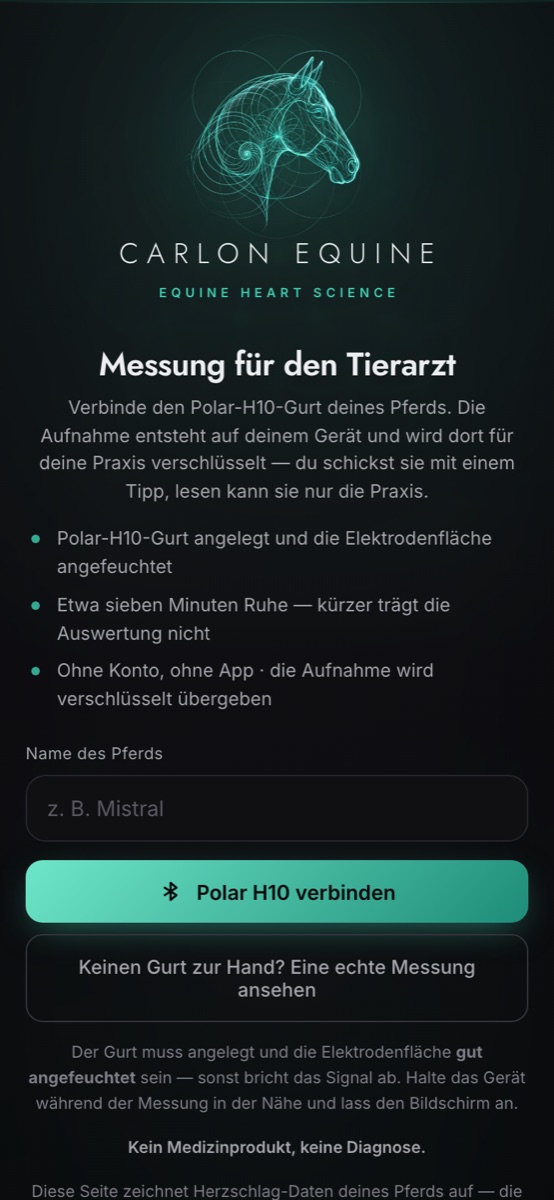
The poster leads here. One field for the horse's name, one button for the belt — nothing else in the way.
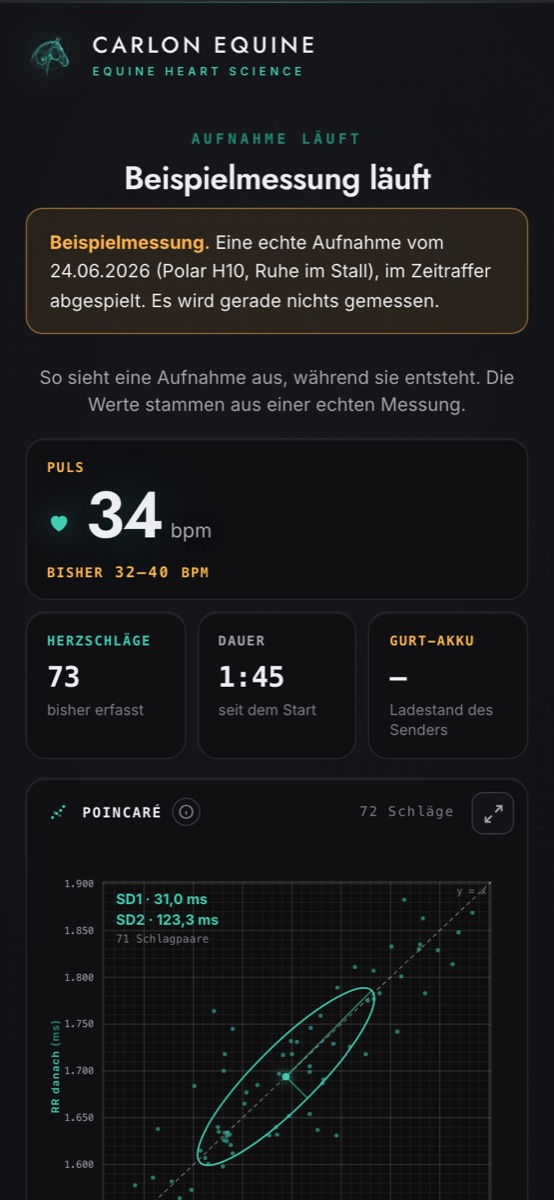
During the recording she can see whether the signal holds — not only afterwards.
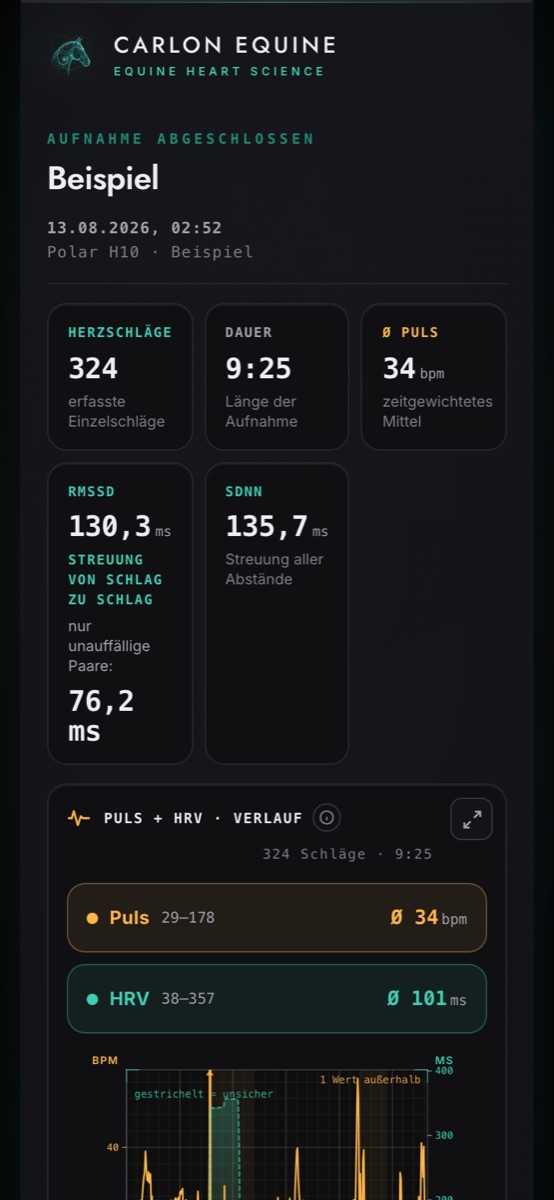
The result, immediately. Two RMSSD values instead of one — the raw one and the one over unremarkable beat pairs only.
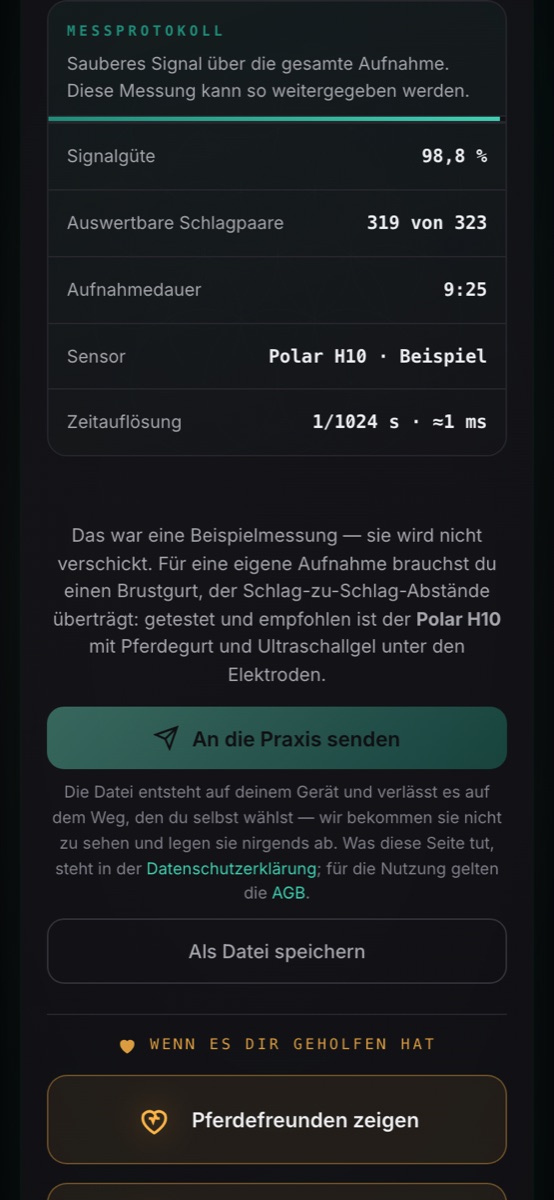
The measurement log states how good the recording is: usable beat pairs, sensor, time resolution.
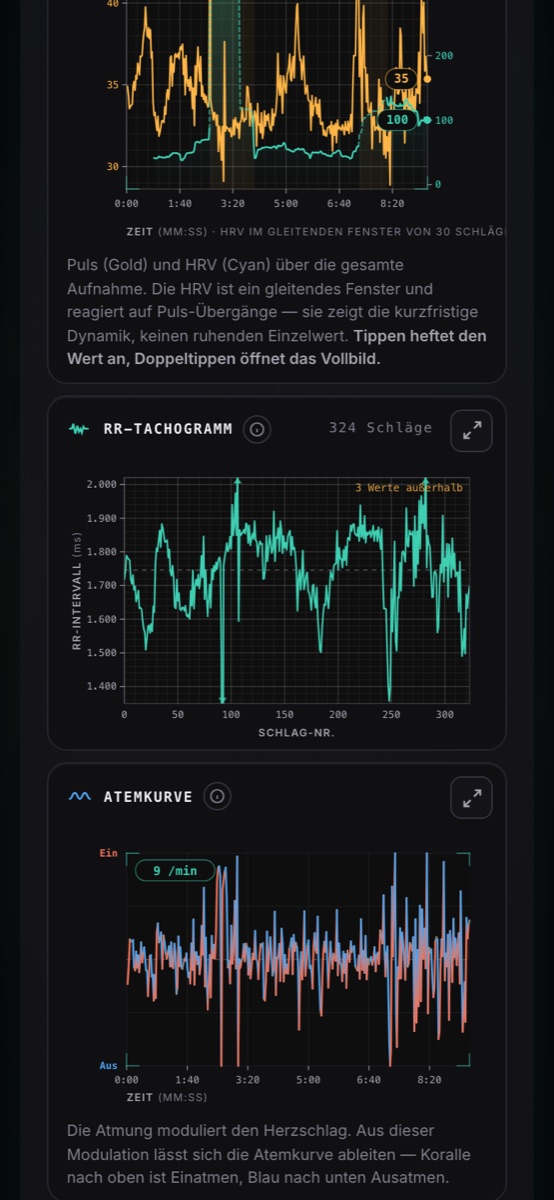
RR tachogram and breathing curve — the same raw data you then analyse in the cockpit.
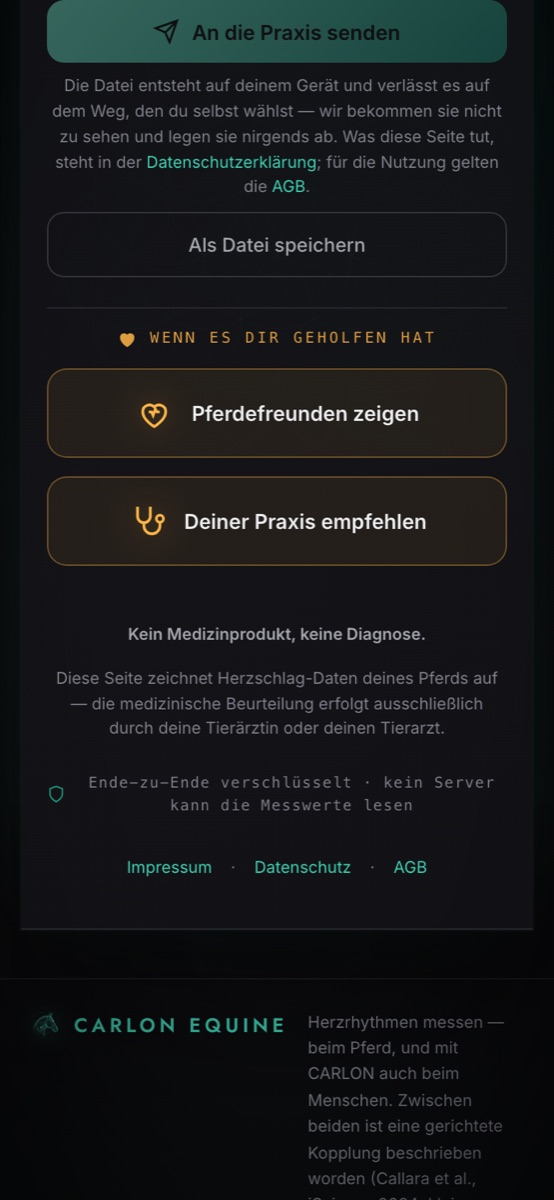
One tap opens her phone's share sheet. The sentence below it is the entire privacy commitment.
Your client experiences your practice, not our software
She records via your measuring link on your recommendation, and the reply carries
your letterhead. The follow-up after a management change that used to fail on
the drive out becomes a touchpoint of your practice.
Two numbers, not one
In horses, physiological pauses — second-degree AV block is normal in a resting
horse — and genuine artefacts occur in the same series. A filter cannot tell them
apart; it discards both. The station therefore reports the raw value and
the one over unremarkable pairs. Which share comes from what is your call, not the
software's.
Nothing passes through us
The moment your client opens your measuring link, the file is already encrypted
against your key on her device. She sends it by whatever route she
chooses. We never see it and store it nowhere — which is why no data processing
agreement is needed between us.
You can try the station yourself right now — even without a belt: it
replays a real recording.
Open the measuring station →
What the cockpit shows
One glance, then the depth.
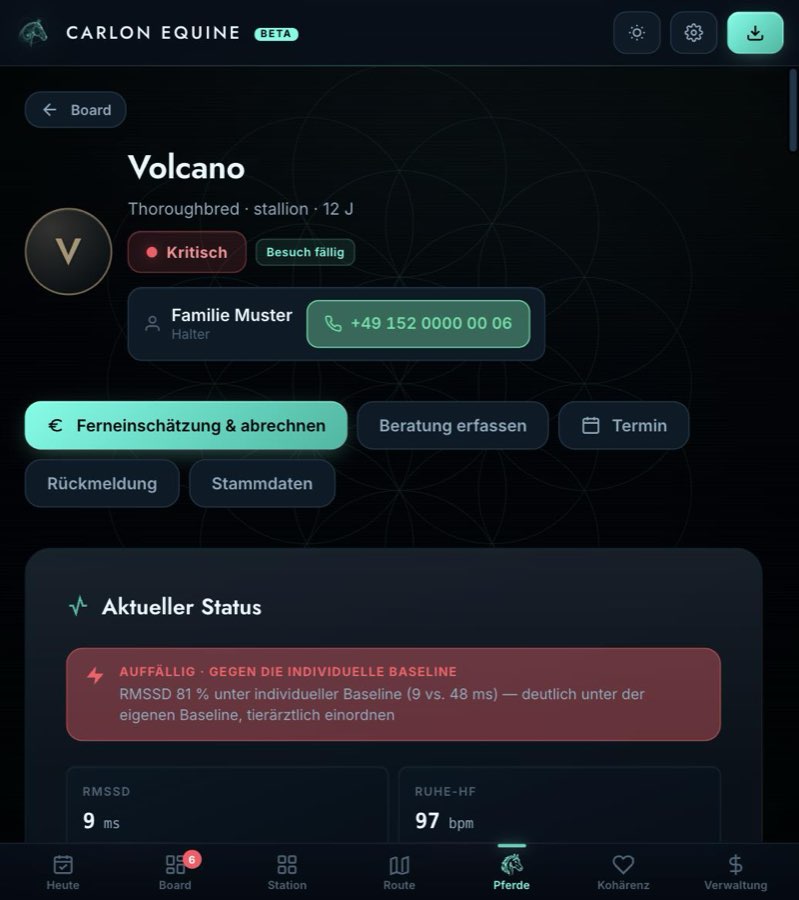
The classification at the top and the value that triggered it. Below it
everything you need to check the maths — none of it hidden.
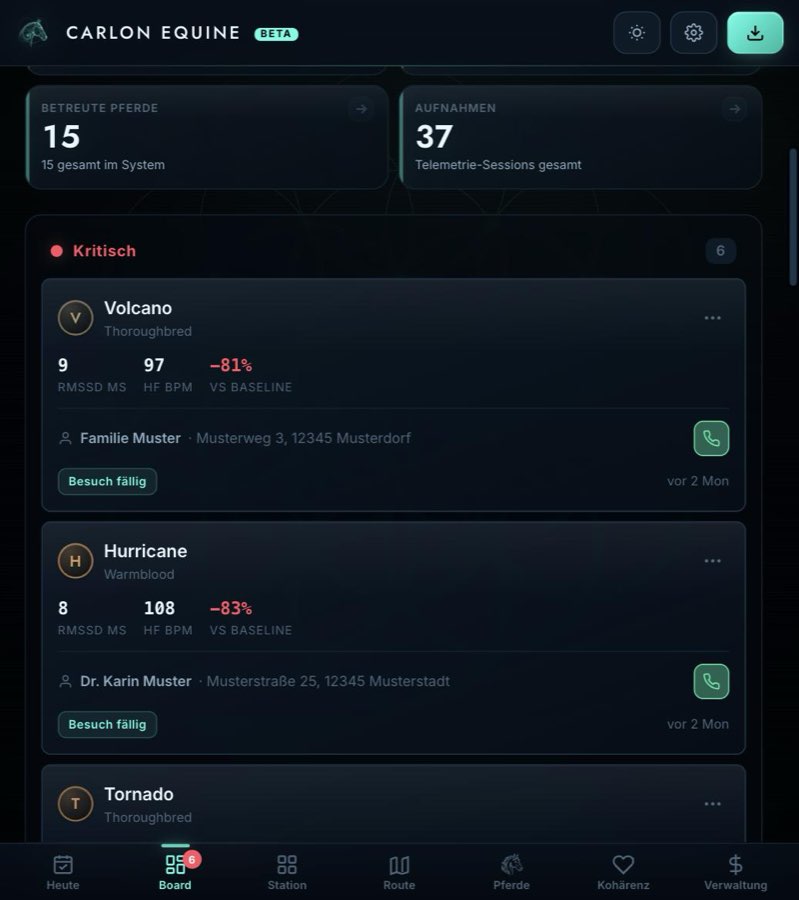
Triage
Four levels, and next to each the value that triggered it.
Sorted by deviation, not by arrival — every horse against its own baseline, not against a table.
The reason is shown with it. A classification without the triggering value would be an opinion.
The owner is one tap away, straight from the card.
The record
Everything you need to check the maths — in one place.
Values against the horse's own baseline, as an indication. The interpretation stays with you.
Signal quality before the number: how many beat pairs actually carry the analysis.
Record and bill the remote assessment without leaving the file.
See the report before you decide anything.Generated from the demo library (fictitious sample data) — key values, heart-rate and HRV
curve, Poincaré plot, RR distribution, power spectrum in the equine frequency bands and the RMSSD
trend across weeks, plus a "Method & limits" section naming the sources.
The report delivers the data; the findings are made by your practice.
Four levels from stable to critical, always with the value that triggered it —
and with the deviation from this horse's baseline, not from a textbook
figure.
Signal quality before interpretation
Share of usable beat pairs, artefact rate, corrected AV-block pauses.
A recording that carries nothing tells you so — instead of showing a number.
Airway markers over time
HRV-based markers with their thresholds, listed individually. The reference study is
Nyerges-Bohák 2025 (Equine Veterinary Journal, n = 40): 20 horses with severe
asthma, BAL-referenced, against 20 unremarkable controls. It reports group
differences, no threshold values — ours sit midway between them
and are therefore our own derivation. An
observational note, explicitly not a diagnosis: BAL
cytology remains the gold standard.
The familiar views, at proper resolution
Tachogram, Poincaré, spectrum, DFA, histogram — the same views as in the iOS app,
redrawn at full size rather than scaled up.
Findings and billing in one place
A findings report on your own letterhead, feedback to the owner, and an overview
of what is still open.
Export without a dead end
JSON, CSV, Kubios-compatible — and FHIR R5 with
LOINC codes for your practice software.
Why the numbers hold
In horses, pauses are normal. Count them in and you measure nonsense.
Heart rate variability is associated with the activity of the autonomic nervous
system — the interplay of sympathetic and parasympathetic tone. It is therefore not
a readout of a state: there is no robust normal value in the horse. That is why the
classification rests on the horse's own baseline. Only the airway markers carry
fixed thresholds in addition — and those are derived from the group means of a
study, not taken from it (Nyerges-Bohák 2025).
A resting horse shows AV-block pauses — physiological, not a finding. Count them in
raw and SDNN and RMSSD rise dramatically, and the markers that respond to
small values flip into the opposite.
Nyerges-Bohák 2025Equine Veterinary Journaln = 40 · 20 sEA BAL-referenced vs. 20 controlsDOI 10.1111/evj.14414Thresholds: our own derivation
No junk in your numbers
AV-block pauses, motion artefacts, implausible beats — the analysis detects
and corrects them before any metric is computed. Whether a
recording comes from the app or from the browser station: you get the same,
cleaned value. And where a file demonstrably did not pass through
the chain, the report says so — those are raw values, and the report states
it instead of claiming a correction that never happened.
Every stage with its threshold →
Too conspicuous is wrong too
Unfiltered, a resting horse looks systematically more conspicuous than it is.
A triage that warns too often is as worthless as one that stays silent —
so the data is cleaned first, classified second. So that a conspicuous horse
stands out because of the horse. Not the measurement.
And where it is not enough, it says so
Too few beats, too short, too many artefacts — then it says “insufficient data”
and gives no verdict. A tool that always says something is not a tool.
642 beats · around 850 msspike 1794 ms
In a real resting recording — 642 beats, 0.31 % artefact rate, rated
excellent by the quality indicator — two beats,
an AV block with its short follow-on beat, are enough to lift RMSSD from
24.2 to 55.5 ms. 130 % too high — and the quality
indicator never warns. A high share of plausible beats says nothing
about whether the metric is right.
What a snapshot cannot do
One value says little. Only its trend gives it context.
A single HRV value in a horse says little — there is no robust normal value to
measure it against. It only becomes meaningful against the animal's own history.
Over weeks rather than minutes
Every new recording joins the line. You see whether the markers improve, hold or
deteriorate — with the time window, the number of measurements and the change
as a figure.
Visible after a change
Housing, feeding, management, convalescence: the follow-up measurement costs no
drive, so it actually happens. As an observation — the assessment stays with
you.
Interoperability
The findings do not stay inside our window.
Every recording can be exported as FHIR R5 — as an
Observation with LOINC codes and UCUM units, the horse as a
Patient with the identifiers you already keep: practice software number,
UELN, microchip, passport. Plus JSON, CSV and a Kubios-compatible export for research,
and a SHA-256 checksum per record for your documentation.
Your working day
Between two appointments lies your drive.
The analysis is one half. The other is the day you have to fit it into — and that
is what decides whether a tool survives its first month.
Day plan
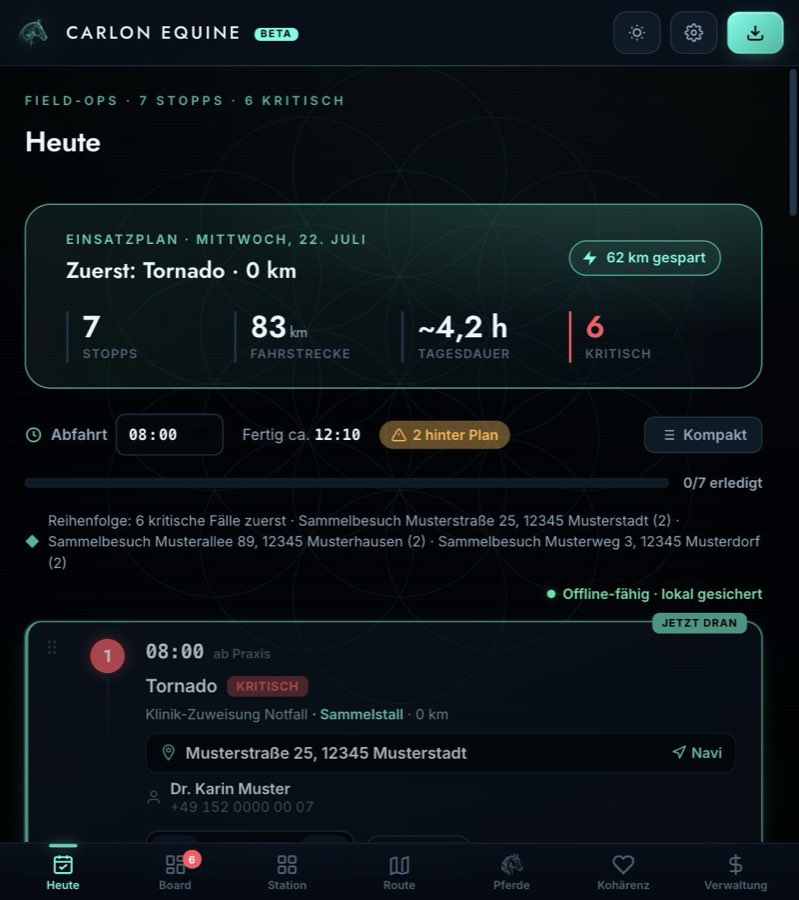
The day sorts itself by urgency, not by the order the calls came in.
The classification orders the stops. Where you see it differently you drag the card — the software suggests, it does not decide.
Die Fahrzeit zum nächsten Stopp steht an jeder Karte, bevor Sie zusagen.
None of it leaves your device on its own — only your tap hands
the route to the maps app.
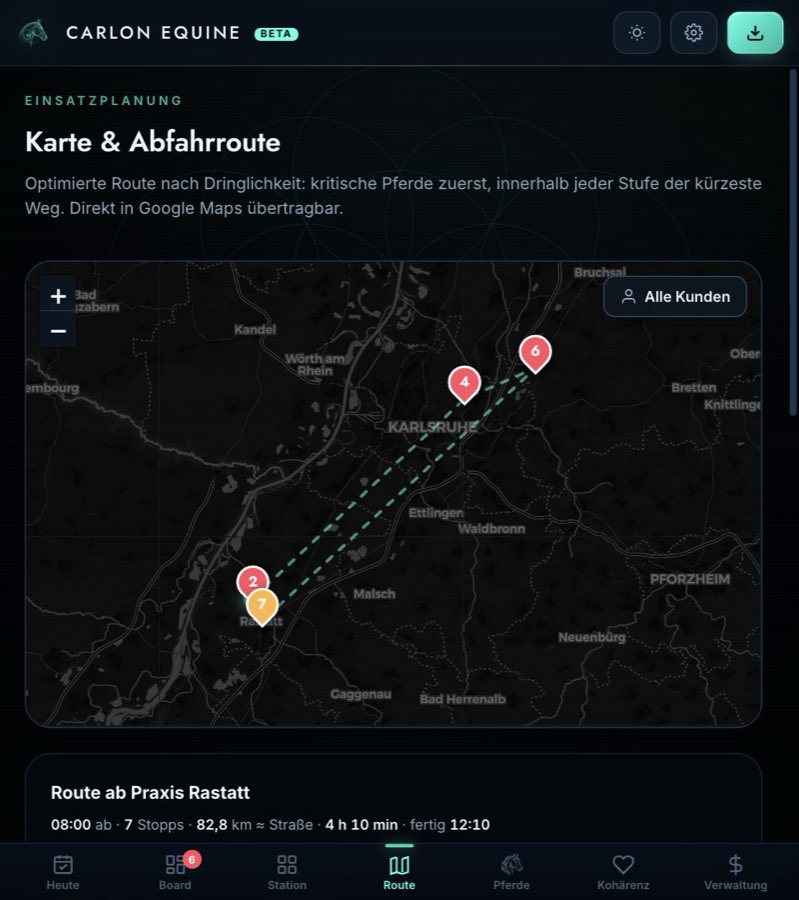
Map & route — the departure order, handed straight to Google Maps instead of retyping addresses.
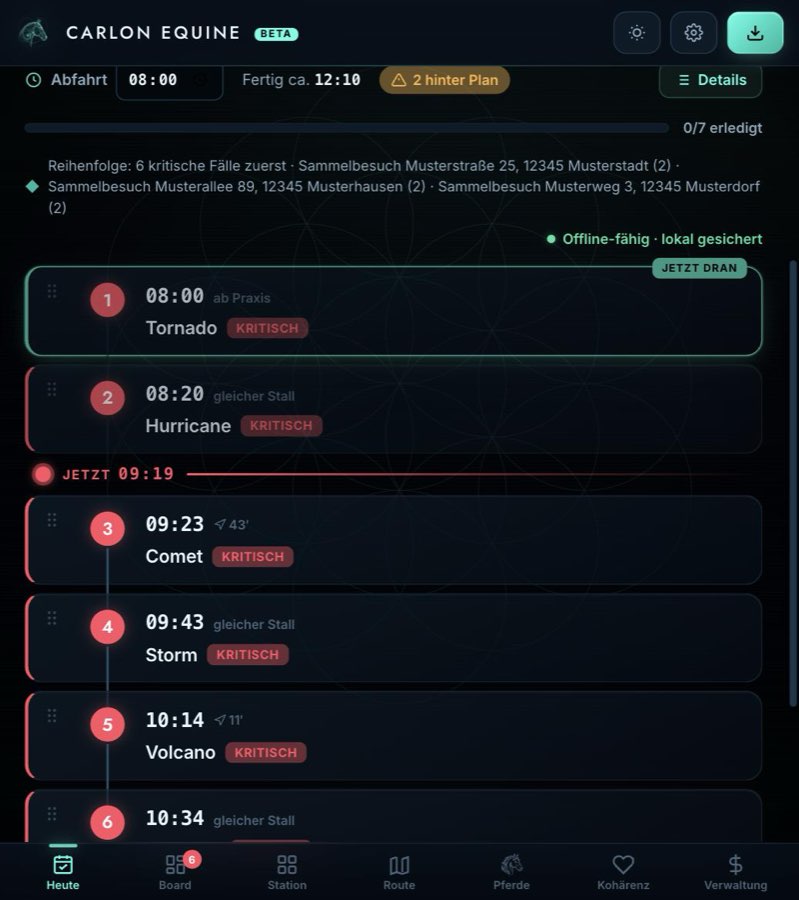
Compact — the whole day on one timeline, when it has to be quick.
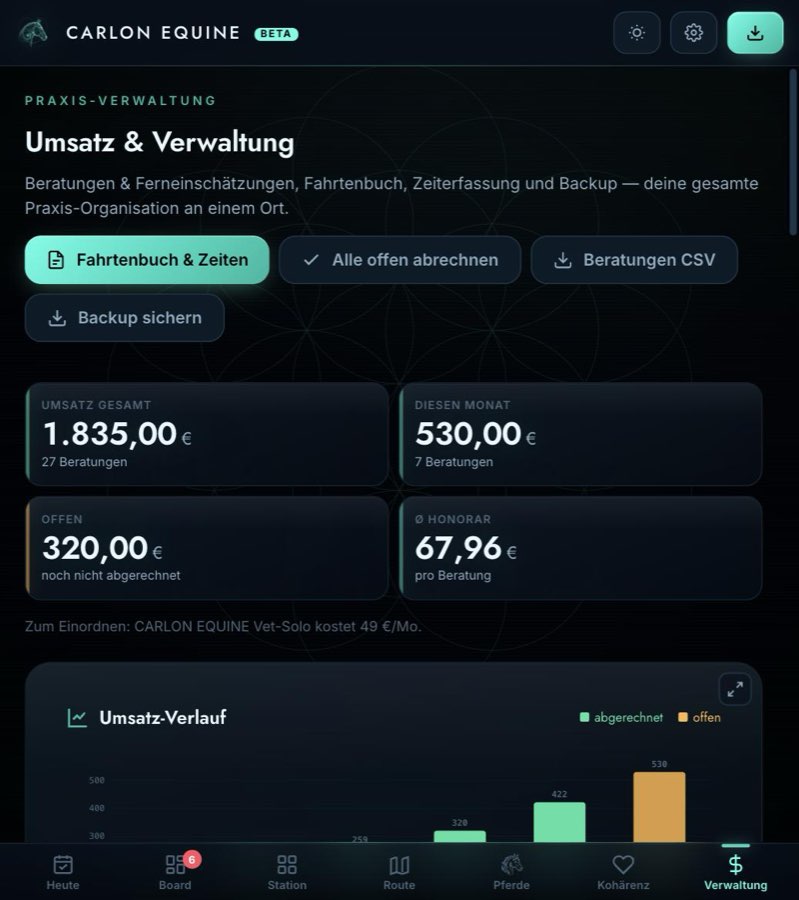
Administration — mileage log, time tracking, billed remote assessments, exported as CSV.
Written or telephone advice without examination is listed in the German veterinary
fee schedule (GOT) as item 1, the veterinary letter per started
15 minutes as item 89. What that comes to at your rate you
can work out better than we can — CARLON only records the remote assessment where it
arises, and exports it as CSV.
Limits we draw ourselves
What CARLON deliberately does not do.
No diagnosis
The software shows measured values, signal quality, trend and deviation. The
medical interpretation remains entirely with you. CARLON Equine Visite is not a
medical device within the meaning of Regulation (EU) 2017/745.
No treatment recommendation
Even when a trend looks unambiguous: whether anything is changed appears nowhere
on the screen. That is your decision, not a metric's.
No database at our end
Your patients live in your device's storage. We have no access and could not
delete them either. The owner's recording never passes through us at all: she
sends you a file — opened via your measuring link, it is encrypted for your
practice from the very first second.
Not an emergency channel
A file someone sends you is not a phone call. In acute cases what always applies
still applies — act veterinarily, immediately.
Getting started
How your practice begins.
Step 1
Share your measuring link
Your cockpit creates your personal measuring link — it carries your key.
Send it as a message, put it on your practice website — or print it as a
QR poster for the barn aisle and the waiting room.
Step 2
The owner opens it and records
One tap on the link or one scan, and the measuring station is there — in the
browser, no app, no account. Every recording is encrypted for your practice
from the very first second; the owner sends you the file on whatever channel
she already uses.
Step 3
Drag the file into the cockpit
Signal quality, baseline comparison and classification are there at once — the
triage places the horse, and the findings report is created straight from the
record.
One price, one practice
One price for the whole business.
One business — one practice or one site — with all veterinary staff and on any
number of that business's devices. There is no fee per horse, per user or
per device and no limit on recordings.
You can work out where it pays for itself in one sentence. A single
drive saved by a remote check is, depending on distance, in the range of half to a
full monthly fee. Add one billable remote assessment — the German fee schedule (GOT)
lists consultation without examination as item 1 and the veterinary letter as
item 89 — and the month is carried by work that would not have happened at all.
Comparable telemetry in equine sport is billed per horse; here you pay once
for the practice.
149 €net per month · VAT charged by Stripe
or €1,490 per year — €124.17 a month, two months saved
Unlimited horses, recordings and trends
All staff, all devices of the business
Findings report on your own letterhead
Export as JSON, CSV, Kubios and FHIR R5
Cancellable monthly, effective at the end of the billing period
This offer is directed exclusively at entrepreneurs within the meaning of § 14 BGB.
We ourselves invoice without VAT under the German small-business rule (§ 19 UStG).
For the browser cockpit, Stripe acts as the seller in its own name
(merchant of record) and charges VAT according to its own status; with a valid EU VAT ID
the reverse-charge procedure applies there. Details in
§ 12a unserer AGB und in der
Datenschutzerklärung.
For scale: the annual price is in the region of a single practice visit including the
drive. Whether that pays off is best decided against your own figures — not ours.
Frequently asked
What vets ask us first.
Does CARLON replace an examination?
No. CARLON prepares trend data and helps with the order of visits. Whether a
clinical examination, further diagnostics or treatment is needed is decided by
you alone.
What does the owner need?
A Polar H10 chest belt and an Android device or a computer with
Chrome or Edge. On iPhone and iPad, Apple does not permit Bluetooth in the
browser; the page directs you to a capable device there.
What happens after cancellation?
The application switches to a reduced mode. Your data stays on the device and can
still be opened and exported. We could not delete it — it is with you.
Do I need a data processing agreement?
No. The cockpit runs entirely in your browser, and the owner's recording never
reaches us either: her measuring station creates a file on her own device, which
she sends to you herself. There is no relay at our end — and therefore nothing a
data processing agreement could be about.
How good can a layperson’s recording be?
Every recording carries its own measurement report: share of usable beat pairs,
artefact rate, sensor, timing resolution. A recording that carries nothing is
flagged as exactly that — you never interpret blind. And the raw data comes
with it: every single beat interval.
What evidence sits behind the airway markers?
The reference study is Nyerges-Bohák 2025 (Equine Veterinary Journal, n = 40):
20 horses with severe asthma, BAL-referenced, against 20 unremarkable controls.
The study reports group differences and names SD2, SDNN, TINN and SD2/SD1 as
the more discriminating measures — it contains no threshold value. Ours sit
midway between its group means; that is our own derivation, not a value from
the literature, and every threshold is listed individually. BAL cytology
remains the gold standard — the trend does not replace it, it substantiates
when it is due.
Does this create a duty to keep watching?
No. CARLON sends no alerts, and the owner sees no classification — it only
comes into being in your cockpit, when you open it. A file sent to you is a
delivery like an email: when you review it is up to you, communicated to your
clients as before. For emergencies, what has always applied still applies:
the phone call.
Where does the baseline come from?
From this horse's own resting recordings: from four recordings on, the value
counts as an individual baseline. Until then the cockpit openly shows that the
comparison value still comes from the reference dataset — and how many of the
horse's own recordings are still missing. It does not pretend to know
something it does not.
Before you decide anything
Fifteen demo horses. Real trends. No account.
The demo cockpit is not a video and not a slideshow, but the complete application.
Open a file, work the views, print a findings report. One horse in the list shows a
downward trend over four weeks — see for yourself from when it becomes noticeable.